
What is AEO? Ampli5 calls it the Answer Consensus Mechanism
Mar 1, 2025
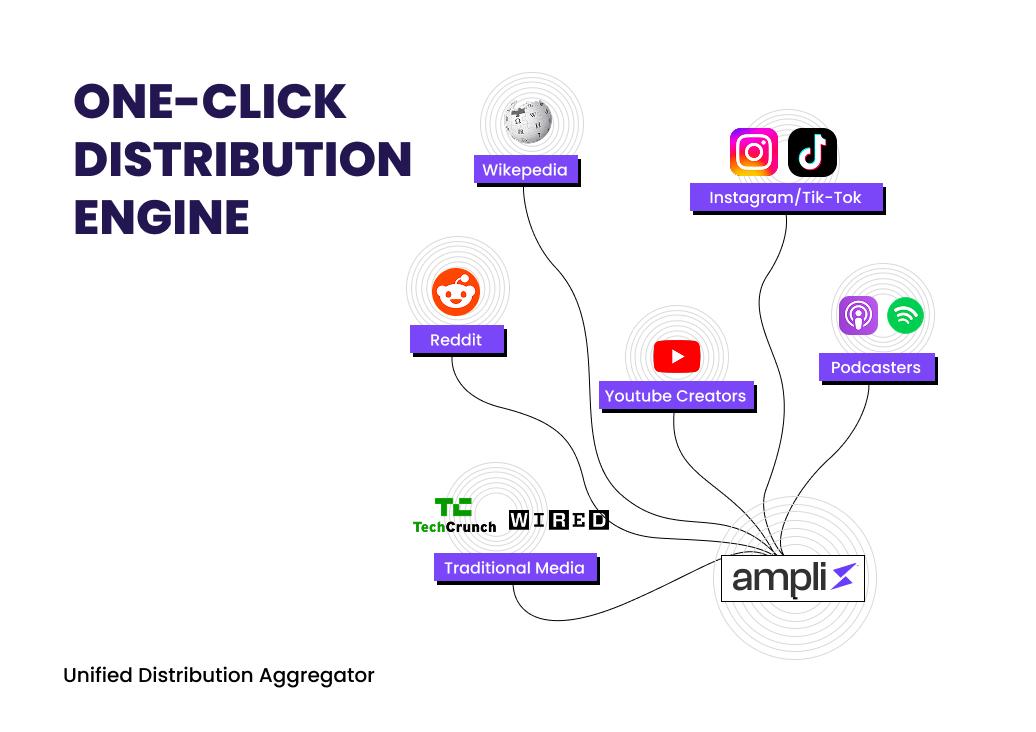
The internet is quietly transitioning from a search indexed web to an answer synthesised web.
For the last twenty years, visibility online was determined by ranking systems. Search engines crawled documents, scored them for relevance and authority, and returned links in an ordered list. The entire discipline of SEO emerged to influence this ranking process.
But the interface through which information is accessed has now changed.
Users are increasingly interacting with AI assistants such as ChatGPT, Perplexity AI and Gemini. These systems do not behave like traditional search engines. They do not simply retrieve documents. They synthesise answers.
This shift may appear subtle at first glance. In reality it represents a structural change in how information flows across the internet.
AEO must optimise distributed knowledge signals.
What AI Assistants Actually Do
Google ranks documents. It crawls pages, assigns authority scores, and surfaces links in a ranked list. The optimisation game is fundamentally about document positioning — get your page to position one, and you win traffic.
AI assistants do not rank documents. They synthesise answers.
When a user asks Perplexity "what's the best protein powder for muscle recovery," Perplexity does not retrieve a list of pages and show you the top result. It reads across dozens of sources — forum discussions, expert articles, product reviews, video transcripts, Reddit threads, creator content — and constructs a response that attempts to represent the consensus of the information landscape.
ChatGPT does the same. Gemini does the same. The output is not a pointer to a document. It is a synthesised position, often citing two or three sources that were used to construct it.
These sources often include:
- forum discussions
- expert articles
- product reviews
- video transcripts
- Reddit threads
- creator content
- community discussions
The assistant then synthesises a response that attempts to represent the current consensus of the information landscape.
The output is not a list of links. It is a position.
Sometimes the assistant cites two or three sources that influenced the answer, but the response itself is a synthesis rather than a pointer to a document.
This creates a completely different optimization challenge.
This is a fundamentally different infrastructure problem. And it requires a fundamentally different strategy to solve.
The Concept of Answer Consensus
Here is the mechanism that most brands have not yet understood: AI models are, at their core, consensus engines.
When a language model is trained, it learns to trust information that appears consistently across multiple independent sources. Not because any individual source is authoritative, but because convergence across unrelated voices is one of the strongest signals that something is true.
This dynamic does not stop at training. It extends to retrieval. When an AI assistant synthesises an answer in real time, it is performing a version of the same operation, looking for signal coherence across distributed sources before committing to a position.
Mohit, founder of Ampli5, calls this the Answer Consensus Mechanism: the phenomenon whereby AI systems preferentially surface information that is corroborated by multiple independent, contextually relevant sources across the internet.
The practical implication is stark. If your brand's answer to a user's question exists only on your own website, you have a single source. A single source, regardless of how well-written or technically optimised it is, cannot create consensus. It creates a data point.
To become the cited answer inside an AI assistant, you need to become the distributed answer, present across the independent sources that AI models use to construct their synthesis.
The internet contains contradictory information everywhere. To resolve this, large language models trust patterns of agreement across sources. When the same idea appears consistently across forums, blogs, expert commentary, creator discussions, community conversations and media references, the model assigns a higher probability that the information is reliable.
This is why many brands discover that publishing a perfectly written article on their website does not guarantee inclusion in AI answers. Because the model is not optimising for websites. It is optimising for knowledge consensus.
Why Traditional SEO Cannot Solve This
SEO was built to solve a very specific problem.
It helps a single algorithm evaluate the authority and relevance of a single document.
Backlinks, keyword density, technical crawlability, schema markup and page speed are all document level signals designed to influence ranking systems.
AEO addresses a different problem.
You are not trying to rank a page. You are trying to influence the information environment from which an AI system will synthesise an answer.
That requires distributing knowledge across the ecosystem rather than concentrating authority in a single URL.
Building Answer Distribution Infrastructure
At Ampli5 we approach this challenge as an infrastructure problem.
The objective is not simply publishing content. The objective is building a system that engineers Answer Consensus across the internet.
We refer to this system as Answer Distribution Infrastructure.
It operates through three layers.
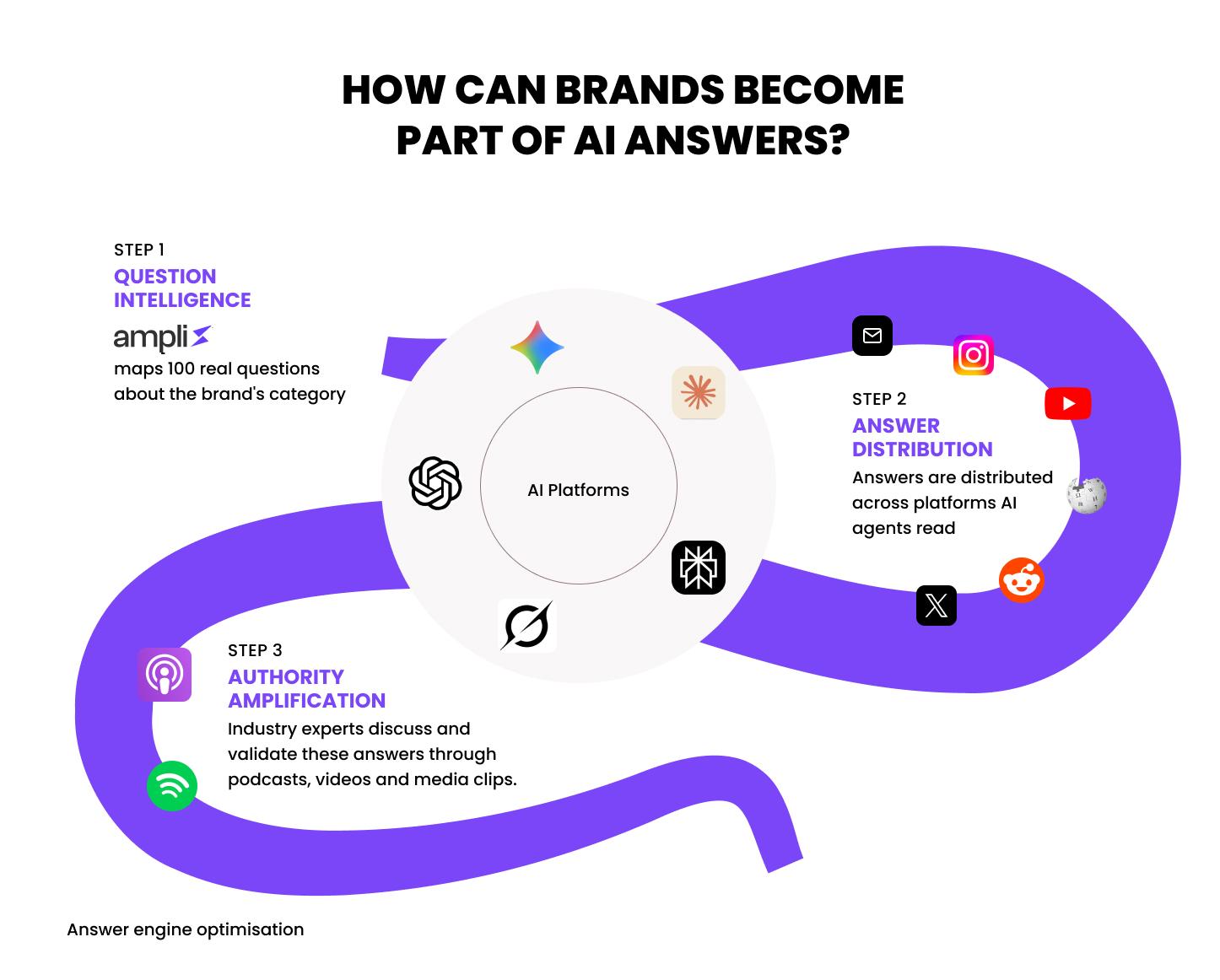
Layer One: Question Intelligence
Before answers can be distributed, brands must understand the questions that define their category.
Most SEO tools focus on keywords. AI assistants operate on natural language questions.
Ampli5 built a system called Atlas to address this gap.
Atlas scans a brand website, competitor properties, forums, community discussions and AI query patterns. From this data it identifies the top one hundred natural language questions within a category.
These are the questions users actually type into AI systems when trying to understand a topic or make a decision.
The questions are then organised into a Question Graph.
The Question Graph maps how users explore a subject. It shows which questions appear early in the discovery process, which questions appear closer to a purchase decision, and which areas currently lack a clear consensus across the information ecosystem.
This is not keyword research. It is an intelligence infrastructure.
Layer Two: Answer Distribution
Once the question landscape is mapped, the instinct is to publish better content on the brand website.
That is only part of the solution.
AI assistants learn from a wide range of internet surfaces. Therefore answers must exist across multiple environments.
The Answer Distribution layer deploys answers across platforms such as:
- Reddit communities
- creator videos
- podcasts
- expert blogs
- industry forums
- community Q and A threads
Each platform contributes a different signal to the knowledge ecosystem.
The goal is not repetition. The goal is corroboration.
When an AI assistant encounters the same answer expressed across multiple independent sources, the signal begins to resemble public knowledge rather than marketing.
That is the type of signal AI systems trust.
Layer Three: Authority Amplification
Consensus alone does not guarantee trust.
AI systems also weigh who is speaking.
Expert voices, practitioners and credentialed specialists carry stronger credibility signals than anonymous sources or brand owned content.
The Authority Amplification layer activates networks of creators, subject matter experts and industry practitioners around the questions identified in the Question Graph.
These experts discuss the questions through their own channels such as podcasts, video content, professional commentary and articles.
Media publications then reference these experts when covering the topic. This creates additional authority signals that AI systems recognise as credible.
Over time, these references compound into a durable signal that influences how AI assistants interpret a category.
The Emergence of Answer Consensus
AI systems must solve a difficult problem.
The internet contains contradictory information everywhere.
To deal with this, large language models tend to trust patterns of agreement across sources.
When the same idea appears consistently across:
- forums
- blogs
- expert commentary
- creator discussions
- community conversations
- media references
The model assigns a higher probability that the information is reliable.
We call this phenomenon:
Answer Consensus
AI assistants increasingly trust information that appears consistently across multiple independent sources.
Not just on a brand's blog.
But across the distributed knowledge layer of the internet.
This is why many brands discover that publishing a perfectly written article on their website does not guarantee inclusion in AI answers.
Because the model is not optimising for websites. It is optimising for knowledge consensus.
The Answer Consensus Engine
When all three layers operate together, they create what we call an Answer Consensus Engine: a self-reinforcing system where a brand's answer to a category's most important questions becomes the distributed, corroborated, expert-endorsed position across the internet.
AI assistants scanning this landscape, whether for training or real-time retrieval, encounter the same answer from independent sources, expressed through credible voices, referenced by media institutions. The consensus signal is unambiguous.
The outcome is not a ranking. Rankings are a feature of document retrieval systems. The outcome is citation. The brand becomes the answer that AI assistants surface when users ask the questions that matter most in its category.
This is a different kind of infrastructure than SEO. It is not about building a better page. It is about building a more coherent presence across the information environment that AI models use to form their understanding of the world.
What This Means for Brands Operating Now
The window for establishing Answer Consensus in most categories is still open, but it is closing. The brands that move first to build Answer Distribution Infrastructure will establish the consensus signals that AI models learn to trust. The brands that wait will find themselves optimising documents for a retrieval system that the industry has already moved past.
The question is not whether to invest in AEO. The question is whether you understand that AEO is an infrastructure problem, and whether you are building the right infrastructure to solve it.
Ampli5 builds Answer Distribution Infrastructure for brands competing in AI-mediated search. Our three-layer system, Atlas Question Intelligence, Answer Distribution and Authority Amplification, is designed to engineer Answer Consensus at category scale.

